Why Organized Retail Crime Can’t Be Solved By Any One Store

Many retailers feel isolated in the fight against organized retail crime (ORC), but no store is facing it alone. ORC groups frequently target multiple locations, brands, and cities within a region. Rarely, if ever, do they stop at just one store. That’s why retailers and loss prevention teams should work together, sharing details and patterns with each other as a community and with police to help build cases against ORC perpetrators.
Blackbird Security has launched Fighting Retail Crime Together, an ORC workshop for retailers, loss prevention professionals, and members of the retail community to come together and learn what they can do to stop ORC. Our next workshop event is on October 28th in Toronto.
Can’t make the workshop, but still interested in learning about ORC? This blog will cover how ORC networks operate, why ORC can’t be stopped on a store-by-store basis, why holidays increase risks, and what a coordinated response between retailers and LPOs across stores looks like.
Key Takeaways
- Because ORC networks operate across multiple stores, brands, and regions, no single store can fully address ORC on its own.
- Sharing incident reports and information between retailers helps connect seemingly isolated thefts to ORC.
- We’re hosting our next Fighting Retail Crime Together workshop in Toronto on October 28 for loss prevention and asset protection professionals.

How Organized Retail Crime Networks Operate
ORC refers to the coordinated theft of typically high-value goods, which are later sold on secondary markets. Unlike shoplifting, where items are stolen for personal use, ORC thefts are carried out by networks of people working together at different levels.
Each person in an ORC network serves a specific function, making the full operation difficult to pin down. These roles usually include:
- Boosters, who steal merchandise directly from stores.
- Drivers, who move merchandise between locations.
- Resellers, who sell stolen goods through informal markets and online.
- Organizers, who direct the whole operation.
ORC can also fund broader criminal activity, including drug trafficking and money laundering. Learn more in our previous blog about ORC.
Why a Single Store Can’t Stop ORC on Its Own
Even a store with a robust retail security team and strategy can only control what happens on its own property. As we mentioned, ORC networks operate across regions, making them essentially impossible for individual retailers to take down on their own.
Here are some additional factors that limit what a single store can do:
- ORC networks can easily replace boosters to stay in operation, meaning that catching and arresting boosters doesn’t stop the network.
- Stronger security at one store can reduce the likelihood that ORC will target it, but it may push ORC groups to the next store down the street.
- Stolen goods are resold through informal markets and online channels, making them difficult to track and recover.
This doesn’t mean retailers are powerless against ORC networks. Every store has valuable information about the incidents it experiences, and that information becomes one of the strongest tools for stopping ORC when it’s shared.
Why Sharing Information Is Key
Gathering evidence and creating incident reports are the most important things a store, its employees, and its retail security team can do to fight ORC.
One incident doesn’t immediately look like ORC, but several incidents with connecting factors can point investigators in the right direction. Police and prosecutors rely on incident evidence gathered across stores and dates to build cases against ORC.
This is where retailers sharing information becomes critical. When retailers can connect the dots between an incident at their store and an incident at another store, they can help expedite the case-building process.
Bill C-14 added a new aggravating factor for retail theft to the Criminal Code, but tougher sentencing helps only when cases are built on strong evidence.
A Coordinated Response to ORC
Stopping ORC means that retailers and their loss prevention teams need to move from individual incident responses to a coordinated, intelligence-led approach. This includes:
- Standardizing how incidents are captured, so reports are consistent across stores.
- Linking repeat events across stores, dates, and jurisdictions.
- Preparing video evidence, witness details, and loss data for police and prosecutors.
- Building relationships with other retailers, investigators, and police before an incident happens.
- Training security guards to recognize the signs of ORC.
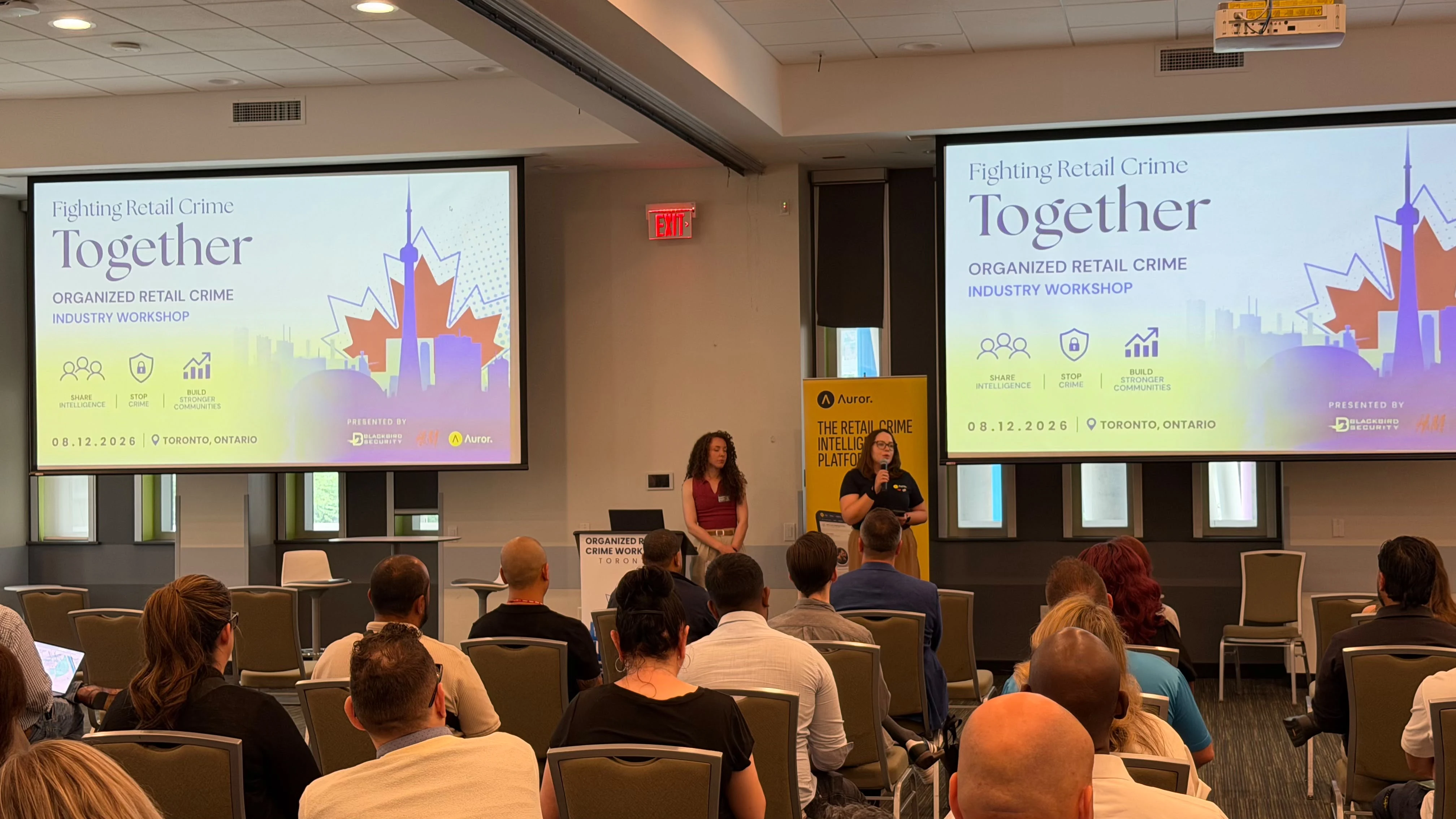
At our August edition of the Fighting Retail Crime Together workshop, loss prevention teams from major retailers, police, and government speakers came together to share what they’re seeing. As one presenter in our previous workshop put it, “Organized retail crime is a network problem. Our response has to be a network response.”
Join Us at Fighting Retail Crime Together on October 28
We’re hosting our next Fighting Retail Crime Together workshop in Toronto on October 28. The workshop gives loss prevention and asset protection professionals, police, and members of the retail community a space to share what they’re seeing and discuss practical ways to fight ORC together.
When we hosted our first workshop on August 12th in partnership with H&M and Auror, interest was so high that we had to move to a larger venue. We’re looking forward to building the conversations started in August and growing the network.
If you’re a loss prevention or asset protection professional and want to attend, contact us to learn more.
Partner With Canada’s Most Trusted Security Company
ORC affects Canada’s entire retail community, and no store can solve it on its own. Retailers are better protected when they work with security partners who understand how ORC networks operate and how to document incidents in a way that supports investigations.
Blackbird Security provides retail security guards and LPOs to retailers across Canada. Our team is trained through Blackbird Academy, our in-house training program, in report writing, customer service, peaceful de-escalation, and first aid to protect stores, customers, and retail teams across Canada.
Contact us to learn how we can help protect your stores this holiday season.
FAQ
What roles do people play in an ORC network?
ORC networks usually include boosters who steal merchandise, drivers who move it between locations, resellers who sell it online or through informal markets, and organizers who direct the operation. Since each person handles one part, removing one person rarely stops the network.
Why does organized retail crime increase during the holidays?
Busy stores make it easier for offenders to blend in, and high-value gift items are in demand for resale. Seasonal staff may also be less familiar with the signs of ORC.
What information should retailers share to help stop ORC?
Incident dates, times, locations, descriptions of suspects and vehicles, methods used, and targeted products are all useful details to record and share. Sharing this information with police and other retailers helps connect incidents and build stronger cases.
What should staff do if they suspect ORC in their store?
Staff should observe and report rather than intervene, since stepping in can put them at risk. They should note as many details as possible, notify security or loss prevention, preserve any video footage, and contact police early.
Who can attend Fighting Retail Crime Together workshops?
Fighting Retail Crime Together is open to loss prevention and asset protection professionals. If you’re interested in attending, contact us to learn more.

More Articles


Frequently Asked Questions
Key KPIs to track include:
- Incident response times: Faster responses to alarms or emergencies.
- Reduction in theft/vandalism: Compare loss data before and after implementation.
- Patrol compliance: Track patrol frequency and adherence via GPS or logs.
- False alarm rates: Lower rates ensure focus on real threats.
- Client/Employee satisfaction: Gather feedback to measure confidence in security.
- Client services: Dedicated account representative who supports ongoing needs & can adjust strategy as needed
- Allowing access to our 24/7 Control centre for all clients, which is based out of our head office in Vancouver, BC. Clients can call this centre and have a mobile guard swiftly deployed to their business for any spontaneous incidents that occur. We believe in operating it inhouse to ensure all services are streamlined and optimized for the best communication. Our control canter can be reached at this number for current clients: 1-888-991-2622.
- We have a dedicated client services team which directly communicates with clients on a day-to-day basis. Our client services often perform site check ups and can assist with any issues that arise at your business.
Your peace of mind is our priority. We’re more than a service provider—we’re a partner in protecting your business. With our team working tirelessly to anticipate and resolve challenges, you can focus on running your business with confidence, knowing we’re always here to support you. Together, we build safer environments and stronger partnerships, every step of the way.
Secure Your Operation Today